5 Incredible Resorts In Bali for your precious honeymoon

Honeymoon is like the big event of every couples that they wouldn't want to ended or forgot it. It's have an impact for years for the couples marriage. you sure don't want this event lead to a ruin because you pick the wrong decision about which places you'll headed and stay to make a honeymoon really a honey-moon not ended up in some kind of nightmare places like that one mosquito destroy your events
and there's never-ending selection of luxury resorts, those heading on luxury honeymoons to Bali often find it a challenge to decide where they want to stay.

We've taken a look at the huge range of Bali resorts on offer and come up with our choice of the best five resorts to head to on a honeymoon. And, with resorts spread across the island in locations such as Jimbaran Bay, Nusa Dua and the quaint fishing village of Tembok, it doesn't matter what your preference is, there is a resort on this list perfect for you.

1. Four Seasons Jimbaran Bay


From the moment you arrive, you will feel as though the Four Seasons Jimbaran Bay was built for those on luxury honeymoons. Found nestled on a hillside overlooking Jimbaran Bay and only 15 minutes from the airport, this hotel truly caters for those looking for romance and privacy.


Each of the resorts 147 luxurious villas are dotted across the hillside and with your own outdoor dining area, sun deck and private plunge pool, your honeymoon to the Four Seasons in Jimbaran Bay is sure to be surreal.

2. The Bale- Nusa Dua


Situated in the exclusive enclave that is the Nusa Dua region of Bali, luxury honeymoons to The Bale will make you think you are in heaven. Catering mostly to adults, with children under 16 not allowed, the Bale offers honeymooners a choice of 29 stunning pavilions located on the hillside overlooking Nusa Dua. With facilities that come standard including king size beds, a huge outdoor shaded dining area and private swimming pool, it is easy to see why this is one of Bali's most popular resorts for those on luxury honeymoons.


3. The Semaya- Seminyak


If you are looking for a romantic resort found right on the beach, the boutique Semaya resort in Seminyak is ideal. Boasting a long list of repeat and recommended guests; take your luxury honeymoons here and you'll stay in a choice of 24 one, two or three bedroom villas. All villas boast a walled garden, plus private plunge pool and elegantly appointed rooms. And, The Semaya Resort is located within a short distance of Seminyak's best restaurants giving you plenty of options for romantic nights out.

4. Spa Village Resort- Tembok


Another of the resorts in Bali to cater solely to those over 16 years old, the Spa Village Resort in the quiet fishing village of Tembok is perfect for those on luxury honeymoons. A quaint boutique resort, Spa Village provides 31 magnificent rooms and as the name suggests has one of Bali's best Spa's. At least one treatment is must while on honeymoon here, where options focus on one of three discovery paths all of which are immersed in Balinese healing traditions.

5. Banyan Tree- Ungasan


Sitting 70m high on the edge of Bali's southernmost peninsula, the Banyan Tree Ungasan offers those on luxury honeymoons a sense of peace and serenity. Each of the resorts 73 villas has its own private garden with plunge pool, outdoor shower and elegant furnishings. This combined with unparalleled views and a resort designed with distinct Balinese influences will ensure your honeymoon to Bali is fondly remembered.
Readmore5 Incredible Resorts In Bali for your precious honeymoon

5 things to do in Bali you will never regret

So many people have said to me that although Bali is a stunning and beautiful island with lots to do, it costs money all the time. Rightly so, if you want to get around town in a lazy way or go up country, get into entertainment places or shop-till-you-drop, or even prop up a bar filling your belly with warm beer on a hot day.

If you use your initiative then there are lots to do in the tourist strip that won’t cost you a cent. Like in most Beach.
Don’t laugh too soon because there is plenty that you can do and, activities where you can enjoy yourself, be amazed and get fit at the same time. If you are travelling on a budget as a lot of travellers to Bali are, then you will find this list of things to do quite useful.

Shopping


'Just Hold a sec’, you might say…that involves money and spending it. On the contrary, visiting anyone of the major department store complexes located in the tourist strip and just window shopping, people-watching or meeting new friends or old ones is an enjoyable experience. The two major complexes in the Kuta area excellent for the aforementioned are the Centro Discovery Mall located on Jalan Kartika Plaza in Tuban and the Matahari Mall in Kuta, each interesting in their own right. But for you want a little bit low cost-money-shopping, i would suggest you go to Krisna located on Sunset Boulevard. It has many souvenir that the price so low *sigh*.. still expensive you say ? Then go to Sukowati Market. There you can buy a lot of stuff that so cheap (if you good in bargaining)

Ceremonies

I have seen a procession of traditionally-dressed Balinese walking down the road single-file carrying offerings above their heads. Even down at Kuta Beach I have come across a ceremony in progress. These were by pure coincidence, however, asking at your hotel about upcoming ceremonies is one way of finding where they are or, ask the locals. It is always important to be respectful at these ceremonies and never get in the way of the Balinese during the ceremony. Or, you can...

wandering around Kuta

Explore, discover and the wonders you will find. Really, It’s easy. Just Walk out the entrance of where you are staying and start walking and I don’t mean just down the main street. Walk down the alleyways (gang, in Indonesia) and see where they go to. If this is not your cup-of-tea then go down to the beach, pick a direction and walk. Best time for this is early in the morning or late in the afternoon.

Visit All the Beautiful Places in this Island

In Bali, The First Place besides Kuta Beach you need to visit is Tanah Lot. See these picture in my first post.
The second place is Uluwatu. You can see the Kecak dance in here. it's hillarious to see this dance. (Girl, Beware, the dancer in Hanoman costume really like to make fun of you)

Then, visit the Lake Bedugul
so Beautiful that Indonesian put it in their money

and, last go to lake Batur. in here you also can see the "funeral" of the bodies

Sunset Drooling

Without a doubt, the most popular free activity for all tourists to the island. Although a tad polluted now compared to it once was a decade ago, the renowned Kuta sunset still draws hundreds of tourists every evening come cloud or rain to witness the golden orb being swallowed up by the inky-blue ocean. Of course getting there about a half hour before the event is recommended as it can be very busy and especially on a day when there are no clouds.


My favourite place to witness this wonder of nature is along the in dreamland Beach. It’s less crowded and if the tide is low, then the photographic opportunities will amaze you.

Oh, don't forget to visit the padangpadang beach (it's the beach in Julia Robert Films, eat, pray and love). It's really beauty, well in my opinion it's more beautiful then Kuta Beach. (If your leg are not tired to do all the hiking if you want to reach there)
It's so high from here to go down in there, but trust me. It's worth it
Readmore5 things to do in Bali you will never regret

Little Introduction about Bali

Sorry if my english was bad, i don't speak english fluently but hey, at least i'm trying right ? since i was an indonesian of course i promoted the tourism in my country first. You may hear a word "Bali" a lot more than a word "Indonesia". Yeah... i know, Bali is more famous than our country.
But if you don't know about bali here's what wiki say about it :


Bali is an Indonesian island located in the westernmost end of the Lesser Sunda Islands, lying between Java to the west and Lombok to the east. It is one of the country's 33 provinces with the provincial capital at Denpasar towards the south of the island.

With a population recorded as 3,891,000 in 2010, the island is home to most of Indonesia's small Hindu minority. In the 2000 census about 92.29% of Bali's population adhered to Balinese Hinduism while most of the remainder follow Islam. It is also the largest tourist destination in the country and is renowned for its highly developed arts, including dance, sculpture, painting, leather, metalworking, and music. Bali, despite being a tourist haven for decades, has seen a surge in tourist numbers in recent years.

Bali was inhabited by about 2000 BC by Austronesian peoples who migrated originally from Taiwan through Maritime Southeast Asia. Culturally and linguistically, the Balinese are thus closely related to the peoples of the Indonesian archipelago, the Philippines, and Oceania. Stone tools dating from this time have been found near the village of Cekik in the island's west.

Balinese culture was strongly influenced by Indian and Chinese, and particularly Hindu culture, beginning around the 1st century AD. The name Bali dwipa ("Bali island") has been discovered from various inscriptions, including the Blanjong pillar inscription written by Sri Kesari Warmadewa in 914 AD and mentioning "Walidwipa". It was during this time that the complex irrigation system subak was developed to grow rice. Some religious and cultural traditions still in existence today can be traced back to this period. The Hindu Majapahit Empire (1293–1520 AD) on eastern Java founded a Balinese colony in 1343. When the empire declined, there was an exodus of intellectuals, artists, priests, and musicians from Java to Bali in the 15th century.


Tanah Lot, one of the major temples in Bali

The first European contact with Bali is thought to have been made in 1585 when a Portuguese ship foundered off the Bukit Peninsula and left a few Portuguese in the service of Dewa Agung. In 1597 the Dutch explorer Cornelis de Houtman arrived at Bali and, with the establishment of the Dutch East India Company in 1602, the stage was set for colonial control two and a half centuries later when Dutch control expanded across the Indonesian archipelago throughout the second half of the nineteenth century (see Dutch East Indies). Dutch political and economic control over Bali began in the 1840s on the island's north coast, when the Dutch pitted various distrustful Balinese realms against each other. In the late 1890s, struggles between Balinese kingdoms in the island's south were exploited by the Dutch to increase their control.

The Dutch mounted large naval and ground assaults at the Sanur region in 1906 and were met by the thousands of members of the royal family and their followers who fought against the superior Dutch force in a suicidal puputan defensive assault rather than face the humiliation of surrender. Despite Dutch demands for surrender, an estimated 1,000 Balinese marched to their death against the invaders. In the Dutch intervention in Bali (1908), a similar massacre occurred in the face of a Dutch assault in Klungkung. Afterwards the Dutch governors were able to exercise administrative control over the island, but local control over religion and culture generally remained intact. Dutch rule over Bali came later and was never as well established as in other parts of Indonesia such as Java and Maluku.

In the 1930s, anthropologists Margaret Mead and Gregory Bateson, and artists Miguel Covarrubias and Walter Spies, and musicologist Colin McPhee created a western image of Bali as "an enchanted land of aesthetes at peace with themselves and nature", and western tourism first developed on the island.


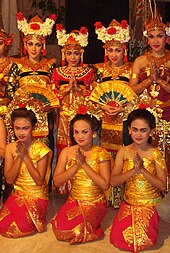
Balinese dancers show for tourists, Ubud.

Imperial Japan occupied Bali during World War II, during which time a Balinese military officer, Gusti Ngurah Rai, formed a Balinese 'freedom army'. The lack of institutional changes from the time of Dutch rule however, and the harshness of war requisitions made Japanese rule little better than the Dutch one. Following Japan's Pacific surrender in August 1945, the Dutch promptly returned to Indonesia, including Bali, immediately to reinstate their pre-war colonial administration. This was resisted by the Balinese rebels now using Japanese weapons. On 20 November 1946, the Battle of Marga was fought in Tabanan in central Bali. Colonel I Gusti Ngurah Rai, by then 29 years old, finally rallied his forces in east Bali at Marga Rana, where they made a suicide attack on the heavily armed Dutch. The Balinese battalion was entirely wiped out, breaking the last thread of Balinese military resistance. In 1946 the Dutch constituted Bali as one of the 13 administrative districts of the newly proclaimed State of East Indonesia, a rival state to the Republic of Indonesia which was proclaimed and headed by Sukarno and Hatta. Bali was included in the "Republic of the United States of Indonesia" when the Netherlands recognised Indonesian independence on 29 December 1949.

The 1963 eruption of Mount Agung killed thousands, created economic havoc and forced many displaced Balinese to be transmigrated to other parts of Indonesia. Mirroring the widening of social divisions across Indonesia in the 1950s and early 1960s, Bali saw conflict between supporters of the traditional caste system, and those rejecting these traditional values. Politically, this was represented by opposing supporters of the Indonesian Communist Party (PKI) and the Indonesian Nationalist Party (PNI), with tensions and ill-feeling further increased by the PKI's land reform programs. An attempted coup in Jakarta was put down by forces led by General Suharto. The army became the dominant power as it instigated a violent anti-communist purge, in which the army blamed the PKI for the coup. Most estimates suggest that at least 500,000 people were killed across Indonesia, with an estimated 80,000 killed in Bali, equivalent to 5% of the island's population. With no Islamic forces involved as in Java and Sumatra, upper-caste PNI landlords led the extermination of PKI members.

As a result of the 1965/66 upheavals, Suharto was able to manoeuvre Sukarno out of the presidency, and his "New Order" government reestablished relations with western countries. The pre-War Bali as "paradise" was revived in a modern form, and the resulting large growth in tourism has led to a dramatic increase in Balinese standards of living and significant foreign exchange earned for the country. A bombing in 2002 by militant Islamists in the tourist area of Kuta killed 202 people, mostly foreigners. This attack, and another in 2005, severely affected tourism, bringing much economic hardship to the island. Tourist numbers have now returned to levels before the bombings.


Topography of the island

The island of Bali lies 3.2 km (2 mi) east of Java, and is approximately 8 degrees south of the equator. Bali and Java are separated by Bali Strait. East to west, the island is approximately 153 km (95 mi) wide and spans approximately 112 km (69 mi) north to south; its land area is 5,632 km².

Bali's central mountains include several peaks over 3,000 metres. The highest is Mount Agung (3,142 m), known as the "mother mountain" which is an active volcano. Mountains range from centre to the eastern side, with Mount Agung the easternmost peak. Bali's volcanic nature has contributed to its exceptional fertility and its tall mountain ranges provide the high rainfall that supports the highly productive agriculture sector. South of the mountains is a broad steadily descending area where most of Bali's large rice crop is grown. The northern side of the mountains slopes more steeply to the sea and is the main coffee producing area of the island, along with rice, vegetables and cattle. The longest river, Ayung River, flows approximately 75 km.

The island is surrounded by coral reefs. Beaches in the south tend to have white sand while those in the north and west have black sand. Bali has no major waterways, although the Ho River is navigable by small sampanPasut and Klatingdukuh are being developed for tourism, but apart from the seaside temple of Tanah Lot, they are not yet used for significant tourism. boats. Black sand beaches between

The largest city is the provincial capital, Denpasar, near the southern coast. Its population is around 491,500(2002). Bali's second-largest city is the old colonial capital, Singaraja, which is located on the north coast and is home to around 100,000 people. Other important cities include the beach resort, Kuta, which is practically part of Denpasar's urban area; and Ubud, which is north of Denpasar, and is known as the island's cultural centre.

Three small islands lie to the immediate south east and all are administratively part of the Klungkung regency of Bali: Nusa Penida, Nusa Lembongan and Nusa Ceningan. These islands are separated from Bali by the Badung Strait.

To the east, the Lombok Strait separates Bali from Lombok and marks the biogeographical division between the fauna of the Indomalayan ecozone and the distinctly different fauna of Australasia. The transition is known as the Wallace Line, named after Alfred Russel Wallace, who first proposed a transition zone between these two major biomes. When sea levels dropped during the Pleistocene ice age, Bali was connected to Java and Sumatra and to the mainland of Asia and shared the Asian fauna, but the deep water of the Lombok Strait continued to keep Lombok and the Lesser Sunda archipelago isolated.

That's what wiki said but i say Bali is beautiful island, you need to visit it before you went away to another world (dead, i mean), have a very rich culture, bla..bla..bla.., so on... so on... and what i'm trying to say is just visit it.
ReadmoreLittle Introduction about Bali